


Table of Contents
Court Philippe-Chatrier has seen Novak Djokovic suffer, survive and eventually conquer often enough that the place almost feels like one of his old arguments with history. He returns to Roland Garros in 2026 not just as a three-time champion here, but as a 39-year-old still chasing the one number that now hangs over every major he plays: 25.
Djokovic has been tied with Margaret Court on 24 Grand Slam singles titles since the US Open 2023, and every Slam since then has gone elsewhere. Paris, though, has opened the door a little. Carlos Alcaraz is out injured, Jannik Sinner sits on the other half of the draw, and Novak Djokovic has already come through an awkward first-round test. The road is still full of danger, but it is a road.
French Open 2026: A rusty start, then a familiar Novak Djokovic recovery
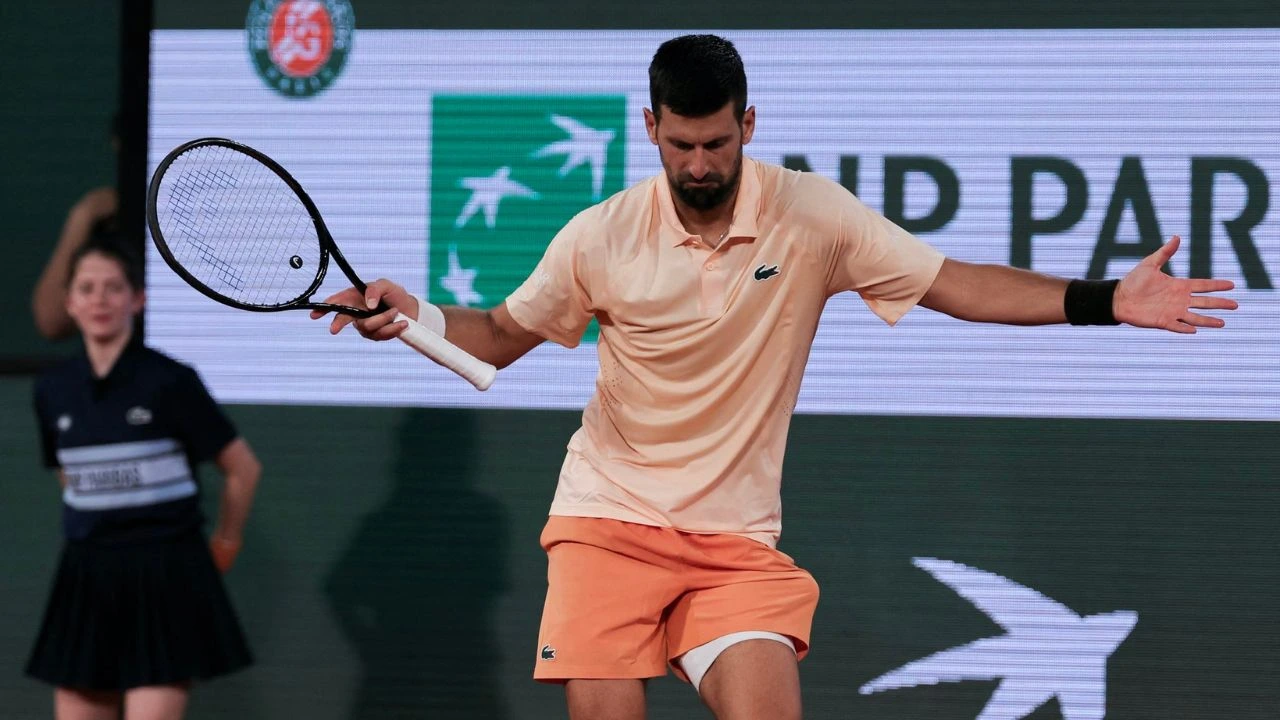
Novak Djokovic did not arrive in Paris looking untouchable. His opening-round match against Giovanni Mpetshi Perricard showed exactly why. The Frenchman’s huge serve, backed by a loud home crowd, pushed Novak Djokovic into an uncomfortable match straight away. He dropped the first set 5-7, struggled for traction on return, and at one stage had failed to convert his first nine break points.
Then the match turned in the way Novak Djokovic matches so often do. He stayed there long enough for the panic to shift to the other side of the net. According to Roland-Garros' official report, Novak Djokovic finally converted his 10th break chance to take the second set 7-5, before pulling away 6-1, 6-4 in the third and fourth for a four-set win.
His own website described the match as an important step physically and competitively, and after it Novak Djokovic joked that three hours on court at 39 was 'just what the doctor ordered.' He now faces another Frenchman, Valentin Royer, in round two.
That opener mattered because it was not a clean, smooth, first-week stroll. It was a stress test. And Novak Djokovic passed it.
The draw to 25 Grand Slam: What stands between Novak Djokovic and history
First major gift in Novak Djokovic's draw is simple: no Carlos Alcaraz. The two-time defending French Open champion withdrew because of a wrist injury, which reshaped the tournament completely. The second gift is structural: Novak Djokovic and Sinner are in opposite halves, meaning they can only meet in the final.
That does not make the path easy. It just makes it possible.
Round 2 brings Royer, a home player ranked outside the elite but dangerous enough to make stretches of the match uncomfortable if Novak Djokovic drifts. After that, the draw starts to tighten. If the projected route holds, the third round could bring either Joao Fonseca or Dino Prizmic, both younger players capable of making a match athletic and noisy.
Second week is where the real weight sits. In the round of 16, Novak Djokovic's section includes names such as Casper Ruud, Tommy Paul and Lorenzo Sonego. Ruud, in particular, is the kind of clay-court opponent who would force Novak Djokovic into a physically demanding baseline match. Beyond that, the quarter-final area includes Andrey Rublev, Alex de Minaur, Tomas Martin Etcheverry and Jakub Mensik, which means there is no soft landing waiting in the last eight.
Then there is the projected semi-final hurdle: Alexander Zverev. If seeds broadly hold, Novak Djokovic is on course to meet the No. 2 seed deep in the tournament. Zverev's serve, backhand and comfort on clay make him one of the more awkward opponents left in the field, especially for a player trying to preserve energy across two weeks.
And only after all of that would Sinner potentially appear in the final. The world No. 1 is on a long winning streak and has looked like the form man in the sport, so the draw has not become easy for Djokovic. It has simply become survivable.
Why this may be one of Novak Djokovic's best remaining chances
There is a reason the Djokovic-at-25 conversation keeps returning to Paris. Alcaraz is absent. Sinner is separated until the final. Djokovic is still one of the very few players in the draw whose baseline discipline, return game and five-set temperament can shrink the court when matches get tight.
He is also a very different threat in best-of-five tennis than in the shorter Masters format. Even when the spring has looked uneven, Grand Slams still seem to bring out the old machinery. He knows how to let a tournament come to him. He knows how to improve round by round. And he knows, perhaps better than anyone, how to make a match feel longer than the other guy wants it to.
That does not guarantee anything. At 39, there is far less room for waste. The early rounds cannot become energy drains every time. The serve has to hold up. The body has to keep answering. And if Sinner is waiting in the final, there may be no margin for sentiment.
But this much is clear: the path to 25 is alive. Djokovic has already taken the first step in Paris, and for a player who has made a career out of turning difficult draws into historic opportunities, that is enough to keep the idea very real.
