


Table of Contents
There are defeats and then there are defeats that live inside you. The kind that do not just hurt on the day but keep coming back years later, in a commentary box, in a conversation with a friend, in the middle of watching a completely different match when something reminds you and suddenly you are back there again.
March 31, 1997, is that kind of day for Indian cricket. Not because India lost. Losses happen. But because of how they lost, and what they had in front of them when they did.
The night before everything fell apart for India
To understand the morning you first have to understand the evening before it. India needed 120 runs to win the Test. One hundred and twenty. With Sachin Tendulkar, Rahul Dravid, Sourav Ganguly, Mohammad Azharuddin and VVS Laxman waiting to bat.
On paper that is not a cricket match, that is a formality. In his autobiography, Playing it my way, Sachin was so certain of victory that he stopped at a restaurant that night and joked with the waiter about Curtly Ambrose.
When the waiter warned him that Ambrose would bounce India out, Sachin reportedly laughed and said if Ambrose bowls him a bouncer he would hit it all the way to Antigua. He told the waiter to keep a bottle of champagne chilled. He would be back to open it tomorrow. He never went back.
What happened on the morning of March 31 for India against West Indies
The West Indies had been set up to lose this Test. Shivnarine Chanderpaul had fought brilliantly for 137 in their first innings to get them to 298, but India responded with 319.
Then on a deteriorating pitch Abey Kuruvilla took a career-best 5 for 68 and bowled the West Indies out for 140 in their second innings. The match was India's to take. Two days left, ten wickets in hand, 120 to win, the greatest batting lineup the country had ever produced.
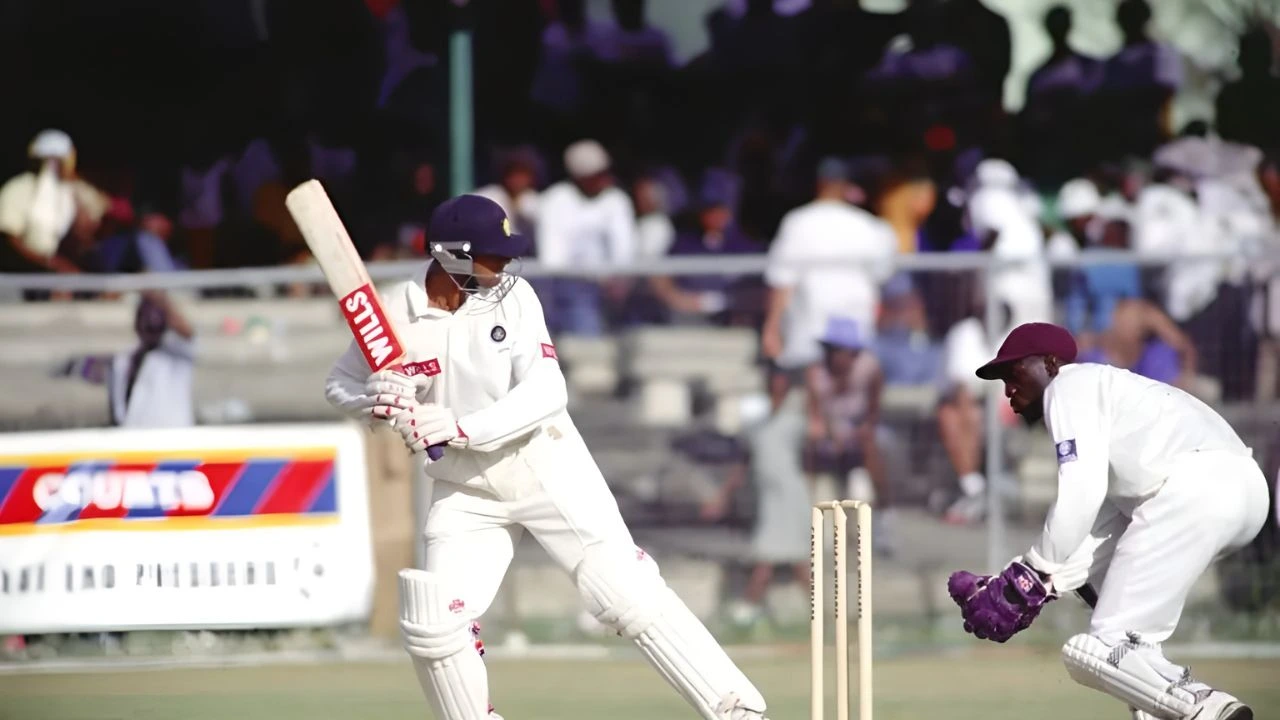
And then the morning of March 31, arrived and Ian Bishop, Curtly Ambrose and Franklyn Rose walked out with the ball and something in the Indian dressing room simply stopped working.
VVS Laxman and Navjot Sidhu opened and Sidhu was gone for 3. At 37 for 2 people were nervous but not worried, Tendulkar and Dravid were at the crease.
Then Bishop produced a delivery that reared up sharply, caught the edge of Sachin's bat, and Brian Lara held the catch at first slip. Four runs. The captain was out for four. The dressing room went silent and it never really recovered.
Dravid followed for 2, strangled down the leg side off Ambrose. Ganguly made 8. Azharuddin made 9, cleaned up by a delivery from Ambrose that shot through low and went under his bat before he could do anything about it.
India went from 37 for 2 to 81 all out in what felt like the space of a single horrifying over. Ian Bishop finished with 4 for 22. The match was over in 35.5 overs. West Indies won by 38 runs.
81 All Out
— Cricketopia (@CricketopiaCom) March 31, 2026
Today in 1997 @ Bridgetown (Lara's 1st Test as captain)
Fall of wickets
1-3 Sidhu
2-16 Dravid
3-32 VVS
4-32 Sachin
5-45 Ganguly
6-51 Azhar
7-57 Kumble
8-66 Mongia
9-80 Kuruvilla
10-81 Prasad
Ambrose 15-3-36-3
Bishop 11.5-4-22-4
Rose 9-2-19-3 pic.twitter.com/yPEtnpg2yV
What it did to Sachin Tendulkar
The scoreline was bad enough. What happened afterward was worse. Sachin shut himself in his hotel room for two full days. He did not eat. He did not speak to anyone.
He later admitted that this was the moment he genuinely considered walking away from cricket at the age of 23, because he felt there was nothing more he could do to make this team win when it mattered.
When he finally came out he called a team meeting and for once in his career the normally composed captain lost his composure entirely. He told the players that losing to a better team was something he could accept.
Losing from a position of complete and total dominance was something else. The champagne sat in the restaurant in Barbados, chilled and unopened, and in a way it has never really been opened since, because Indian cricket carried the weight of that morning for years afterward.
Why it still matters for India and Indian fans
This remains the lowest target India have ever failed to chase in Test cricket. One hundred and twenty runs. It is a number that commentators still bring up whenever India are chasing something modest in difficult conditions abroad.
It birthed the phrase "tigers at home, lambs abroad" and gave a generation of Indian cricket a psychological scar that took the better part of a decade to heal.
It took the arrival of a different kind of mental toughness, the kind that Sourav Ganguly helped build as captain, the kind that eventually produced the team that won in Australia and South Africa and England, to finally put March 31, 1997 somewhere in the past rather than somewhere in the present.
But it is never fully in the past. It never will be. Because in cricket, no target is small enough to be taken for granted, and on a Monday morning in Barbados in 1997, the greatest batting lineup India had ever assembled walked out to get 120 runs and came back with 81 on the board and a wound that has never quite healed.
