


Table of Contents
On this day in 2003, a twenty-year-old from Burnley walked through the Long Room at Lord's for the first time in a Test match, wearing an Admiral kit that England's cricket team would retire within a few years, against a Zimbabwe side that had no idea they were about to be dismissed for 147 by someone who had not yet played a full professional season.
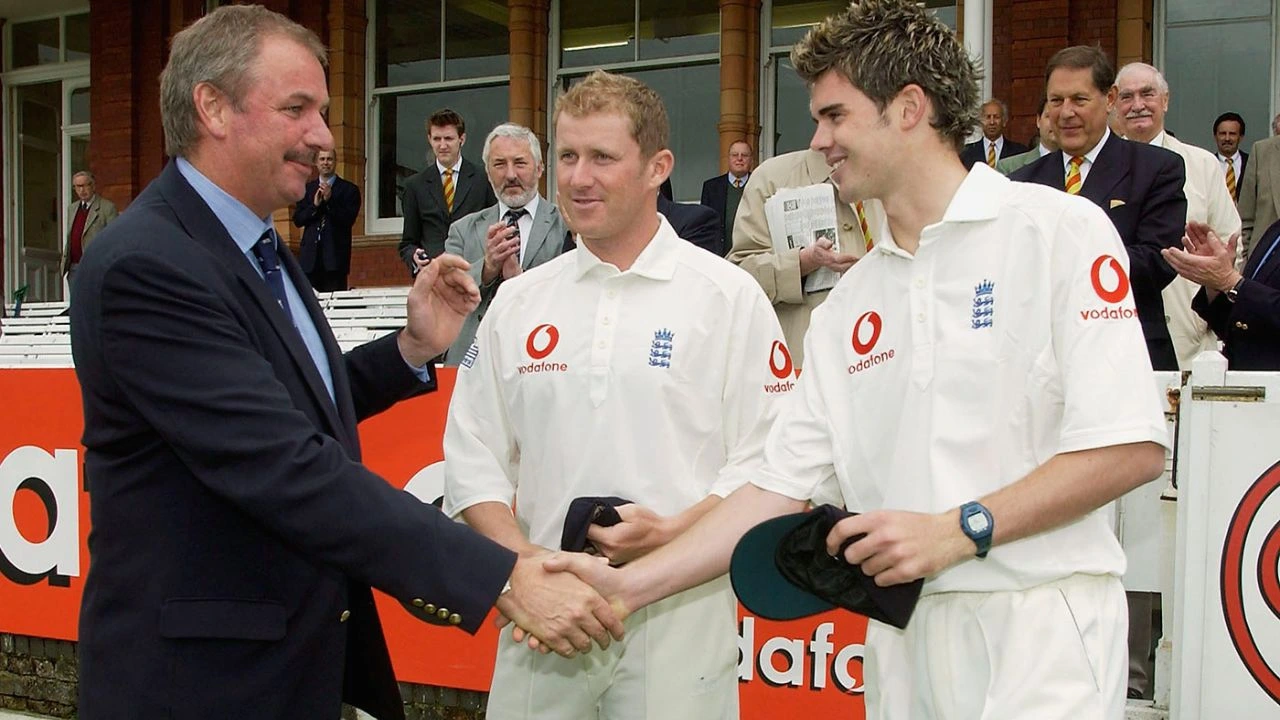
The morning James Anderson announced himself at Lord's
Facebook did not exist. YouTube did not exist. MS Dhoni had not made his international debut. Rafael Nadal had not won a French Open. Apple had not built the iPhone. The first T20 international had not been played. And Jimmy Anderson had not taken a Test wicket.
By stumps on May 22, 2003, James Anderson had five of them.
The thing about James Anderson's debut that makes it so worth revisiting is not just that it went well, lots of debuts go well, and most of those players disappear into county cricket within three years and you spend a decade trying to remember their names. What makes it worth revisiting is the specific context of the person standing at the top of that Lord's run-up.
A raw, fragile twenty-year-old who had emerged from the Lancashire academy, played some promising one-day cricket at the World Cup in South Africa, and been selected on the basis of a swing game that was brilliant in the right conditions and almost nonexistent in the wrong ones. The kind of player, in other words, that selectors pick for one or two Tests, thank warmly, and then forget about when the pitches flatten out.
187 Tests
— England's Barmy Army 🏴🎺 (@TheBarmyArmy) May 22, 2024
348 innings
6,646.1 overs
1,720 maidens
700 wickets
32 five-wicket hauls
3 ten-wicket hauls
🐐 Jimmy Anderson made his Test debut on this day in 2003!
One final dance this summer... 🥹 pic.twitter.com/djhyXHOCqG
Four wickets in fourteen balls and suddenly England had found something in form of James Anderson
England captain Nasser Hussain won the toss and elected to bowl. The clouds were doing what English May clouds do. James Anderson ran in and in his very first spell dismissed Zimbabwe opener Mark Vermeulen with an outswinger that clipped the off stump, the kind of delivery that announces an arrival. He did not stop there.
A spell of four wickets for five runs in fourteen balls prompted a Zimbabwe collapse of eight wickets for sixty-eight runs. He finished the first innings with five for seventy-three, became the forty-second bowler in English cricket history to take five wickets on debut, and had his name on the Lord's honours board alongside people who had played in the 1800s. He was twenty years old and apparently amazed by this. "I have seen players up there from the 1800s," James Anderson said afterwards, "and I am honoured to have my name up already."
Zimbabwe followed on three hundred and twenty-five runs behind and were dismissed for two hundred and twenty-three in their second innings. England won by an innings and ninety-two runs. James Anderson went home to Lancashire as a Test cricketer.
📅 #OnThisDay at Lord's in 2003, @jimmy9 made his Test debut!
— Lord's Cricket Ground (@HomeOfCricket) May 22, 2019
The rest is history 🙌#LoveLords pic.twitter.com/PutENkJd2J
The part people forget is that it almost did not work out
And then, because this is the part of the story that makes everything else more interesting, it nearly all fell apart. By the winter of 2003, James Anderson was shaping up as the archetype of the bright-flash debutant. He could not articulate his talents or deliver them to order. The swing that had made him magical at Lord's was absent on flatter pitches.
He was raw and fragile and the numbers in the months after his debut looked nothing like the person who had been added to the Lord's honours board. The cricket press, which is not known for patience with young fast bowlers, was ready to write the epitaph. A meteoric six-month rise and fall, surely an unrepeatable fluke.
What happened instead was one of the most remarkable long-game stories in the history of sport. James Anderson spent the next two decades doing the quiet, unglamorous, unspectacular work of becoming extraordinary. Economy of movement. Economy of runs.
Learning surfaces that his swing-based game was supposed to be unable to conquer, Asia, Australia, the hard flat pitches where the ball does nothing and the bowler must manufacture everything from craft alone. James Anderson adapted. And adapted again. And kept adapting.
The howling yorkers of his youth gave way to late outswing at sixty miles per hour, which gave way to reverse swing, which gave way to the kind of matchcraft that only exists in bowlers who have been doing this long enough to understand every possible situation and have a plan for all of them.
Also READ: Kane Williamson returns as New Zealand announce squad for England, Ireland Test series
Twenty years later he left as the greatest fast bowler the format has seen
Numbers at the end of it: seven hundred and four Test wickets at an average of 26.45 across a hundred and eighty-eight matches. Both runaway records for a fast bowler in Test cricket. Two hundred and sixty-nine ODI wickets, an England record.
All of it constructed from the same swing and the same Lancashire stubbornness that first showed itself on a cloudy May morning at Lord's when Facebook and YouTube and the iPhone and T20 cricket and an England ICC trophy all still belonged to the future.
England tapped James Anderson on the shoulder in 2024 to retire him. Left to his own devices, he would probably have kept going. He was forty-one. He had long since stopped being the fragile twenty-year-old who got lucky against Zimbabwe. He was the most successful fast bowler in the history of Test cricket.
On this day in 2003, he had just taken his first five wickets. None of what came after was visible yet. But it was all there, already, in that first outswinger that clipped Vermeulen's off stump at Lord's on a cloudy May morning, in the kit that England would soon replace, in the era when the world was a completely different place and Jimmy Anderson was just getting started.
