


Table of Contents
India won the T20 World Cup 2026 on March 8 in Ahmedabad, and fans closely followed the celebrations. Sanju Samson was everywhere, the man who scored 89 in the final and won the Player of the Tournament award. Jasprit Bumrah took 4 for 15 and got the credit he deserved. Ishan Kishan's explosive starts throughout the tournament were all over social media. Suryakumar Yadav lifted the trophy as captain, as everyone got their moment and a name in the headlines.
And then a video started circulating online. Nobody was completely sure when it was filmed. The Adidas jersey suggested it was recent, somewhere around the time of the World Cup, but whether it was before the final or after it, nobody could say for certain.
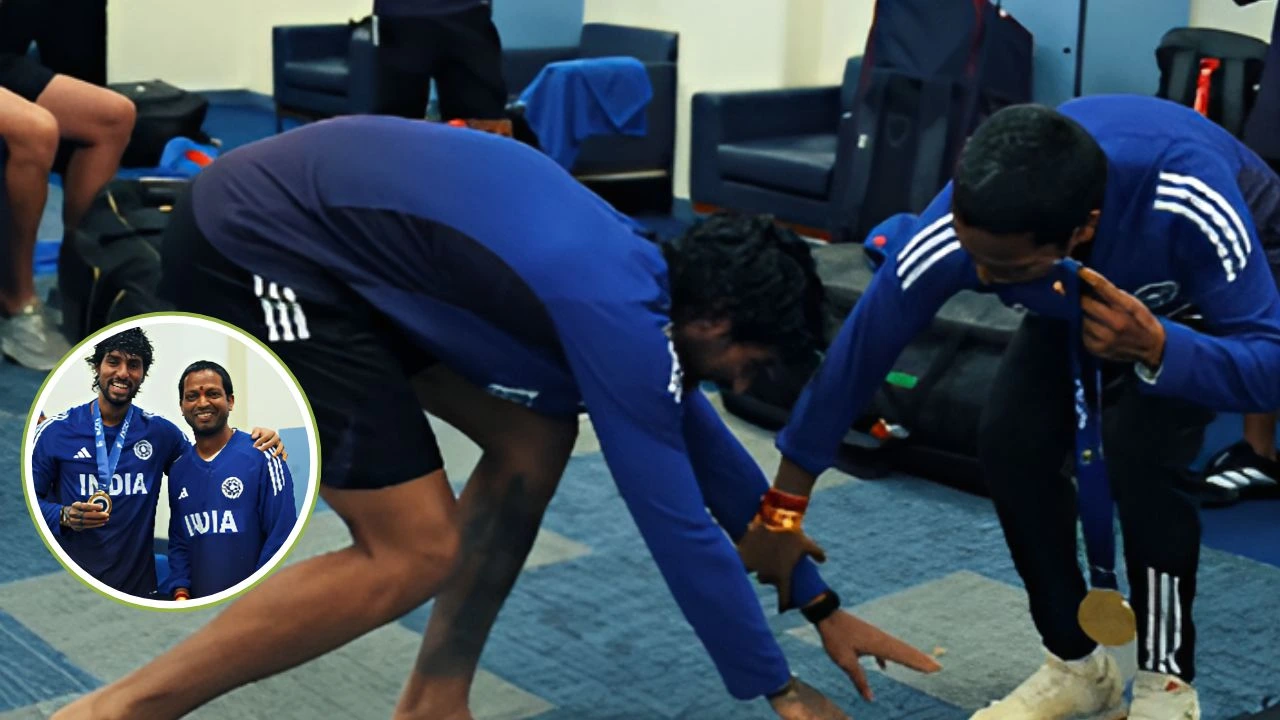
In the video, Tilak Varma, one of India's match winners throughout the tournament, bends down and touches the feet of a man standing quietly in the background. Not a player or a coach. Not anyone whose name was trending that night. Just a man in the background receiving the kind of respect that players in India reserve for the people who matter most to them.
Most people watching the video had one question. Who is that?
The man who slept in a crematorium and ended up in India's World Cup dressing room
His name is Raghavendra Dwivedi. Everyone in Indian cricket calls him "Raghu." He is a throwdown specialist and has been part of the Indian team setup since 2011, when Sachin Tendulkar recommended him to the national team. For over fifteen years, Raghu has been in those nets, throwing ball after ball at the best batters in the world at speeds most international bowlers cannot reach.
His story starts a long way from any cricket ground. Raghu grew up in Kumta in Karnataka and left home against his father's wishes with INR 21 in his pocket and a dream of playing cricket for India. He ended up in Hubli with nowhere to stay. The police moved Raghu on from the bus stand. He tried a temple. Eventually, Raghu found an abandoned building within a crematorium and lived there for nearly four and a half years, using a cricket mat as his blanket. He had nothing except the belief that he belonged in cricket somehow.
A hand fracture ended any realistic chance of playing professionally. Most people would have walked away at that point. Raghu did not. He stayed in the game, started helping local players with throwdowns in Hubli, and eventually made his way to Bangalore (Bengaluru now), where Raghu worked at the Karnataka Institute of Cricket and then the National Cricket Academy. Javagal Srinath noticed him. The Karnataka Ranji team brought him in. And then in 2011, Sachin Tendulkar watched him work and made a phone call that changed everything.
Why Virat Kohli says facing him in the nets makes match bowling feel slow
What Raghu does sounds straightforward. He throws balls at batters in the nets using a sidearm slinger. What makes him different is that he does it at 150 to 155 kilometres per hour consistently, session after session, across years and tournaments and continents. For a batting lineup preparing to face the fastest bowlers in the world, that kind of preparation matters more than most people realise.
Kohli explained it simply. "Hum logon ka fast bowling khelne ka jo improvement hua hai, usme major contribution Raghu ka hai. Jab Raghu ko khel rahe ho net mein, uske baad aap jab match mein jaate ho toh aisa lagta hai aapke pass time hai."
MS Dhoni called him an overseas pace specialist for his ability to replicate fast bouncy conditions. Ravi Shastri called him the heartbeat of the Indian cricket team. When India won the series, the players would hand Raghu the trophy to lift first. Not as a formality. As a genuine thank you.
He works alongside Nuwan Seneviratne, the left-arm throwdown specialist, and between them, they prepare India's batters for everything international cricket can throw at them. Ishan Kishan and Abhishek Sharma both worked extensively with Raghu before the World Cup, developing the kind of six-hitting ability that defined their batting throughout the tournament. The runs and the wickets that happened in Ahmedabad had a lot of preparation behind them, and a big part of that preparation had Raghu's name on it.
Also READ: “Not that kind of bowler?” Alastair Cook raises eyebrows over Jasprit Bumrah’s Test spells
Tilak Varma's moment
When Sanju Samson was asked about his Player of the Tournament award, he spoke about the people behind the scenes who made it possible. When Jasprit Bumrah takes five wickets in a World Cup game, the credit goes to the player himself, and it should. When Ishan Kishan hits three sixes in the powerplay, the highlights show Kishan, and they should.
That is how sport works. The players on the field get the recognition, and the people in the background do not.
But every now and then, something cuts through. A video of Tilak Varma, a World Cup winner, bending down to touch the feet of a man standing quietly out of frame. No one in the mainstream coverage noticed. The people who knew about Raghu shared it immediately, and those who didn't started asking.
And the answer is a story that starts with Rs 21 and a crematorium in Hubli and ends with a man standing in the middle of an Indian World Cup celebration that he helped create. The cameras will always follow Sanju Samson and Jasprit Bumrah for the World Cup success, and they have earned that. But somewhere in every one of those celebrations for the last fifteen years, Raghu has been there too.
The players always know where to find Raghu. Tilak Varma just made sure everyone else got to see it, too.
