


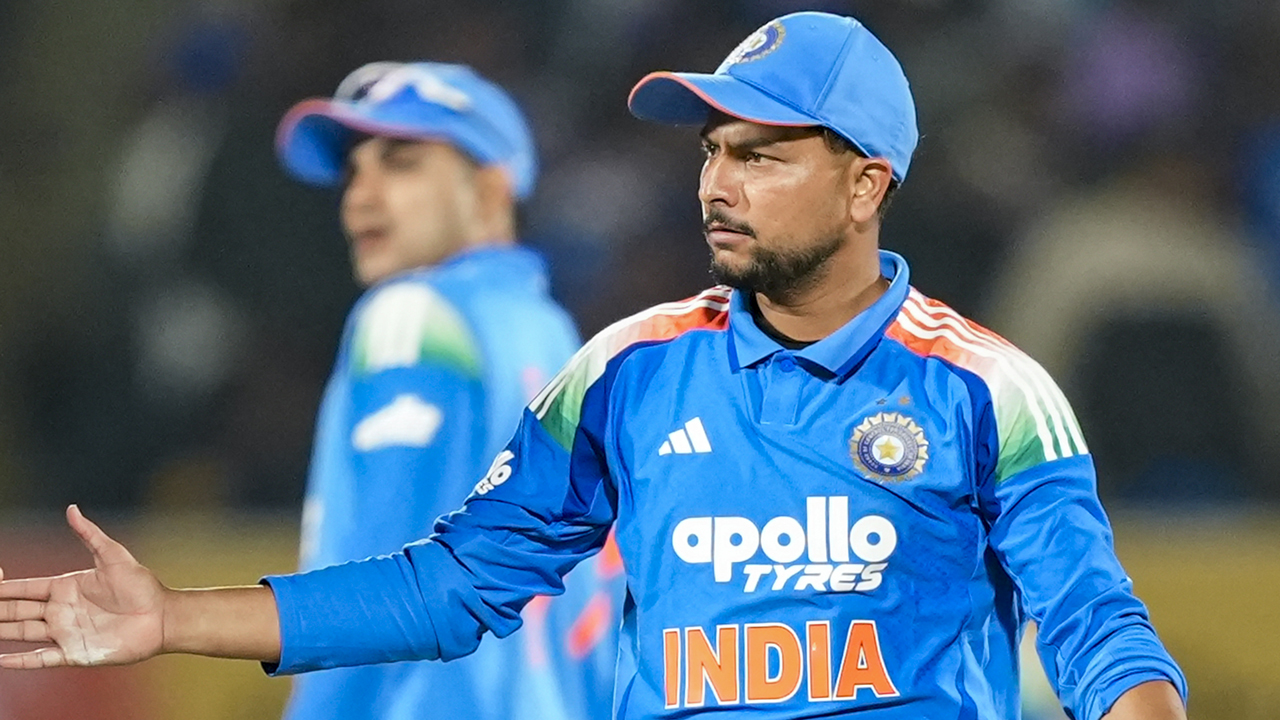
NEW DELHI: India may need to rethink their bowling strategy for the series-deciding third ODI against New Zealand in Indore on Sunday, especially after their spin attack struggled to make an impact in the opening two matches. While India's batters also found it difficult to score freely against New Zealand's slower bowlers, it was the lack of control in the middle overs that stood out as a major concern.
New Zealand's convincing win in the second ODI at Rajkot, which brought the series level at 1–1, highlighted India's problems during the middle phase of the innings. Kuldeep Yadav, in particular, found it hard to settle into a rhythm and was unable to provide either control or regular breakthroughs.
Mitchell unsettles Kuldeep
Daryl Mitchell led the charge against Kuldeep, repeatedly stepping out to upset his lengths and neutralise the turn. The New Zealand batters also used the sweep shot with great effect, a tactic that had served them well in other formats, leaving India's plans in disarray.
Overall, India's spin unit failed to build sustained pressure, a sharp contrast to New Zealand's spinners, who tightened the screws, slowed the scoring rate and forced mistakes. With the Holkar Stadium known for its flat pitch and short boundaries, success in Indore will depend more on accuracy and discipline than on relying solely on variations.
India's bowlers, particularly Kuldeep, will need to bowl flatter, attack the stumps and use the bigger pockets of the ground smartly, rather than offering flight that can be easily exploited. Controlling the lengths and cutting down boundary options will be critical on a ground where mis-hits often go for six.
Washington's absence cost India dearly
The absence of injured Washington Sundar was felt without a doubt in Rajkot while his replacement Nitish Kumar Reddy bowled only two overs.
Based on the conditions, Ayush Badoni, who bowls off spin, perhaps is a better fit in the XI instead of Reddy but it remains to be seen if the team management drops him after just one match.
The curious case of Arshdeep
The team management may also look to strengthen the pace attack to offset the risks associated with bowling spin. It will be interesting to see if left-arm Arshdeep Singh is given a look-in.
If he has to come, then Prasidh Krishna, who, though, has not done badly in the first two games, will have to make way.
The only thing that can go against Prasidh is the length he bowls. His natural length is back of the length that can be exploited on a small ground while Arshdeep with his fuller length can be a more effective weapon at Holkar stadium.
Early wickets with the new ball could be crucial to preventing New Zealand from setting a platform similar to the one they enjoyed in Rajkot.
Mohammed Siraj is certain to lead the attack, while the final composition could depend on whether India opt for an extra pace option alongside Ravindra Jadeja as the lone spinning all-rounder.
Settled batting order
With the bat, India are unlikely to tinker with their core group.
Shubman Gill, Rohit Sharma and Virat Kohli, KL Rahul and Shreyas Iyer remain central to the hosts' plans.
At Holkar, where totals can quickly spiral beyond control, India will need to focus on early breakthroughs, tighter middle-overs bowling and smarter use of angles and fields.
With the series on the line, execution rather than experimentation is likely to define India's approach in the decider.
India have an imposing record at the Holkar Stadium, having won all five of their previous matches at the venue. India beat England (2006, 2008), West Indies (2011), South Africa (2015) and Australia (2017).
The Indian team skipped practice on Friday while the Kiwis sweated it out despite it being an optional session.
(With PTI Inputs)
