


Table of Contents
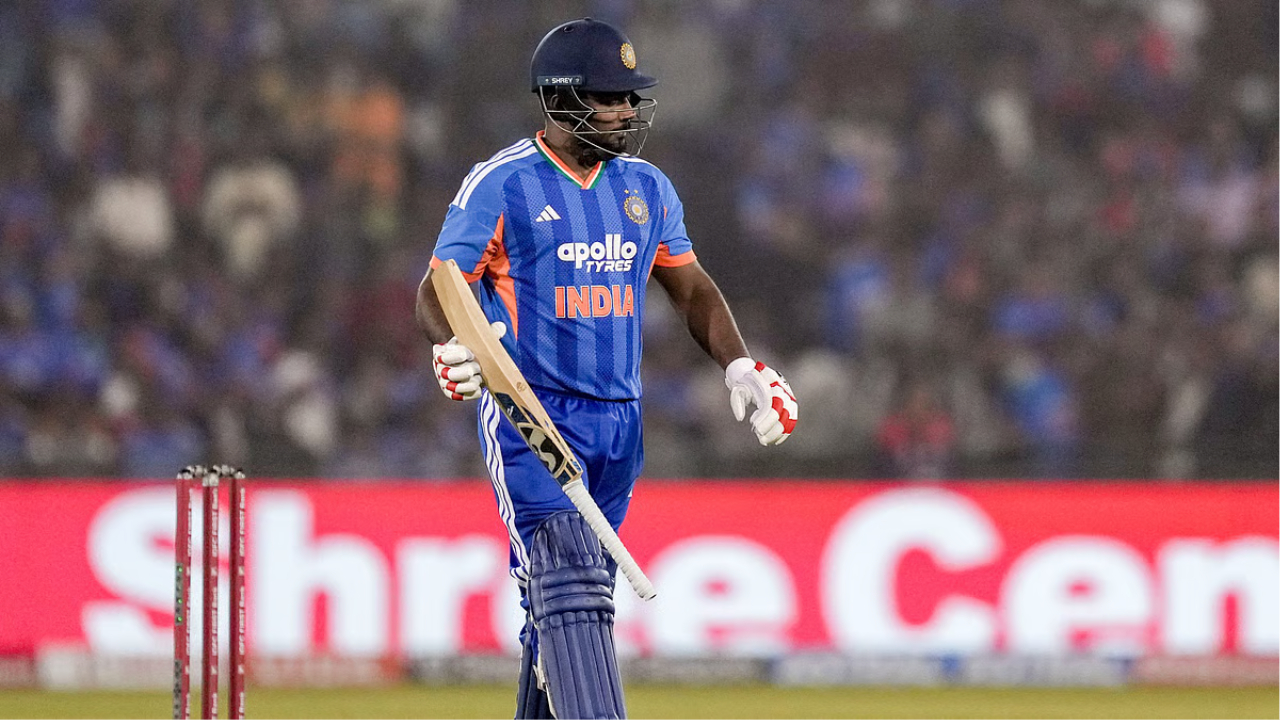
NEW DELHI: For more than a decade now, Sanju Samson has remained one of Indian cricket’s most intriguing contradictions — a batter blessed with rare elegance and obvious talent, yet someone whose T20I journey has been riddled with baffling inconsistency.
His recent struggles — scores of 10, 6 and 0 — in the first three games against New Zealand only underline the concern.
The contrast looks even sharper when viewed alongside his closest competitor Ishan Kishan, whose golden run has caught the imagination of fans and experts alike.
Numbers tell a story, data tells a trend
There is often confusion between statistics and data, though the two are not the same. Statistics present a straight-line picture, while data digs deeper into those numbers to identify patterns and trends.
Across 55 T20Is spread over 11 years, Samson has scored 1048 runs at a strike-rate touching 147 (average being largely irrelevant in modern T20 metrics), with three fifties and three hundreds — two of those coming in South Africa towards the end of 2024.
His strike-rate against Australia stands at 131, drops to 118 against England and further dips to 113 against New Zealand.
Whenever Samson has opened since 2025, certain trends have clearly emerged.
How teams have figured him out
England cracked the code early last year, bowling fast and short into his body across five successive matches, forcing hurried pull shots that lacked timing and power.
In 2026, Matt Henry (twice) and Kyle Jamieson, operating in the mid-130s, have attacked him with straight lines or around leg-middle, denying him the freedom to open up on the off-side.
To get a clearer picture of the issues affecting his batting, PTI spoke to former India opener WV Raman, one of the country’s most respected voices on batting technique, and Rajasthan Royals High Performance Director Zubin Bharucha, who has worked closely with Samson.
"Sanju has a bit of problem both on technical and mindset front. The bat-speed on his downswing is the same for bowlers with different speeds. It will fetch him success against bowlers in the 130 kmph mark.
"But anything above or less than 130 kmph mark with variations in pace either way, will create issue. The solution is to adjust his bat-speed on the downswing according to the pace of the ball. Once he does that, he should be alright," Raman said when asked whether the issue was technical or mental.
"On the mental front, he knows that there is a lot of competition for the wicketkeeper-batter's slot in white ball cricket. That's all probably putting pressure on him because he still has enough talent to work this out. He is capable player and can deliver for India," Raman said.
Mind games and the way forward
Raman does not necessarily believe that frequent role changes, including batting in the middle order, have unsettled Samson, especially in an era where players pride themselves on flexibility.
"In the T20Is, he is suited for top three and he shouldn't have any issues on that front because that is where he can perform at his best. These days, these boys talk about adaptation and being able to bat anywhere.
"There shouldn't be a problem unless you are sent extremely down the order," Raman said.
Samson, by his own admission, is a confidence-driven player. A few years ago, he recalled on a podcast how, after a low score, he quietly walked out of the stadium and sulked along Marine Drive.
For Bharucha, who has worked with several Rajasthan Royals youngsters including Samson, Yashasvi Jaiswal and Dhruv Jurel, the issue lies largely between the ears.
"There is nothing technical at all. It's all in the mind for him. He oscillates from mercurial to average because of lack of clarity but it happens with everyone.
"Every player that's played the game goes through this, he is no exception - Surya (Suryakumar Yadav) just recently. It's just a matter of learning to manage it better," feels Bharucha, who has done extensive work on the finer technical aspects of batting.
Ravichandran Ashwin recently spoke about how New Zealand attacked Samson with straighter lines, while England relied on pace and short bowling.
"In such situation, it's just about hitting a few more balls in areas you feel might be weaker than your strength. He has been scoring a lot more runs on the off-side than on-side, deliberately," Bharucha said.
"This is what all batters do, making the bowler bowl an off stump line but get into positions to score from that line. Now this immediately prompts the bowler to compensate and come inside (middle and leg) and from that position it should be easier and less risky to hit into the on-side.
"Sometimes when you overly set-up to open up the off-side, you can be a little out of position for the leg-side. Just requires a little more awareness around it because Samson already has the on-side shots."
Asked about the solution, Bharucha replied: "Hit a few more balls in that area during practice. Ideally, constantly get the throwdown expert to move from the off stump line to the leg stump line."
(With PTI Inputs)
