


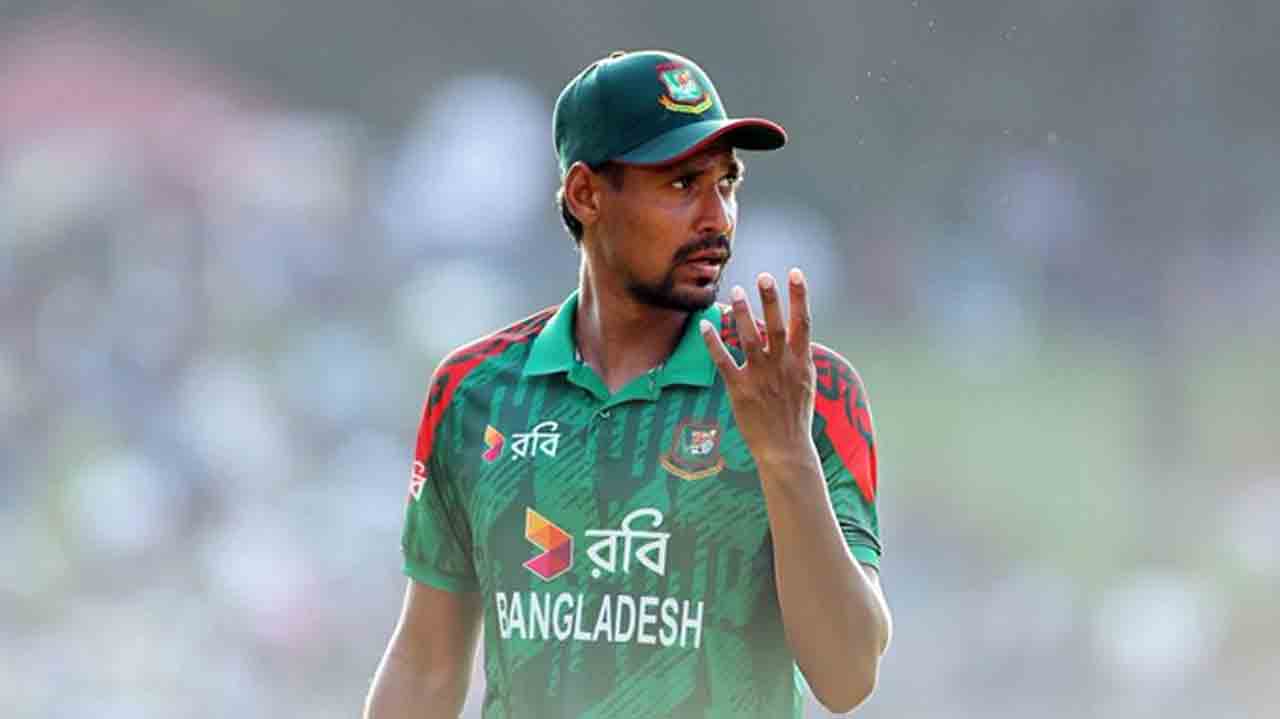
NEW DELHI: Former ICC Head of Communications Sami-ul-Hasan Burney has criticised the BCCI's handling of Bangladesh pacer Mustafizur Rahman's exit from the IPL, saying a more measured approach by the Indian board could have prevented the T20 World Cup from sliding into its current state of turmoil.
Rahman's release from his Kolkata Knight Riders contract set off a domino effect, ultimately resulting in Bangladesh withdrawing from the tournament scheduled to begin on February 7 after refusing to play matches in India citing "security concerns."
In a subsequent show of support for Bangladesh, Pakistan announced it would forfeit its high-profile group match against India on February 15, following directions from its government.
What led to the turmoil?
Burney, who later served as the Pakistan Cricket Board's media director after his stint at the ICC, argued that the BCCI mishandled the situation by publicly announcing Rahman's release and offering explanations that were unnecessary, suggesting the matter could have been handled quietly to avoid escalation.
"I mean, things could have been easily avoided if the cricket administrators or people responsible for the game had been a little bit more careful and avoided public statements, like a Bangladesh player (Mustafizur) has to be removed from the franchise," Sami told PTI.
"I mean they (the BCCI) didn't have to say it publicly. They could have easily privately told the franchise (KKR) to release the player and nobody would have known what happened and life would have moved on.
"Sometimes you make an error of judgment and make a statement which has implications. So the January 3 announcement became a trigger," he explained.
ICC accused of double standards
Burney, a former journalist with Dawn, spent over a decade working at the ICC's headquarters in Dubai and served as the PCB's Media Director until last year.
Offering insight into the thinking at the top of Pakistan cricket, Burney also shed light on PCB chairman Mohsin Naqvi, who doubles up as the country's Interior Minister and is widely regarded as the second-most powerful figure in Pakistan's central government.
Burney believes that his former boss has looked at ICC's refusal to change Bangladesh's venues from India to Sri Lanka as "shifting of goalposts."
"I refer back to November, 2024, when I was a part of the Pakistan Cricket Board, and I was with Mr Mohsin Naqvi, when that e-mail came in which the ICC said the BCCI has informed them that the Indian government has refused permission to send their team to Pakistan.
"Mr. Naqvi believes when a similar situation arose in January (with regards Bangladesh), the same principles were not applied, and that is where he is referring to the double standards.
"I think that is what is upsetting Mr. Naqvi and the PCB, because they think goalposts are being changed, or shifted."
'PCB can sustain'
Asked if Bangladesh's conflict with India was Pakistan's fight, he replied: "We may agree with it, we may disagree with this decision, we may argue...but when the government makes a decision, they are looking at something bigger than what what you and I are seeing."
The ICC has indicated that the PCB could face some punitive action, including financial penalties and loss of revenue which could amount to millions of dollars but Burney believes that Pakistan must have been taken this decision keeping implications in mind.
"I mean, these decisions are not easy decisions to make. They must have spoken to a lot of people, sought the advice from the experts, looked at the legal side.
"I am sure an extensive exercise would have taken place before the government of Pakistan made that decision. As regards the sanctions or the losses you are talking about, that one match is costing USD 250 million (everything accounted for not just broadcaster's loss).
"Pakistan's annual revenue is USD 35.5 million, so there is a big, big difference," he said.
Burney also pointed to the fact that Pakistan have somehow survived the financial loss of not being able to play India bilaterally for two decades now.
"...unlike other countries, Pakistan have not hosted India for 20 years in a bilateral series, even though they have toured India twice in 2007 and then 2012-13 for white-ball cricket.
"They have not played, I mean, they were playing off-shore for 10 years, 2009 to 2019 not at home, but in the Middle East, or in the UAE, and still managed to win two tournaments, the T20 World Cup in 2009 and 2017 Champions Trophy," he said.
"So, yes, there will be financial implications, but if Pakistan Cricket Board can survive that 20-year period without playing India, they can sustain."
(With PTI Inputs)
