


Table of Contents
In the high-octane world of international cricket, the difference between a century and a pavilion walk is often measured in millimetres. Recently, Indian spin maestro Ravichandran Ashwin took to X (formerly Twitter) to break down the dismissal of Shubman Gill during the India vs. New Zealand series. In a fascinating thread, Ashwin didn't just critique a shot; he offered a window into the complex mind and muscle memory of a modern-day batter.
A Tale of Two Conditions
Ashwin’s analysis began by referencing a point made by the legendary Sunil Gavaskar ("Sunny bhai"). Gavaskar had noted that during Gill’s successful run in England, his bat stayed remarkably close to his pads, a hallmark of tight, defensive Test batting. However, back in home conditions, that discipline seemed to waver.
Ashwin used this observation as a launchpad to illustrate a universal struggle for multi-format players: the "automatic" changes that creep into a batter's technique when switching between the explosive demands of white-ball cricket and the patience required for the red ball.
The Anatomy of the Error by Ravichandran Ashwin
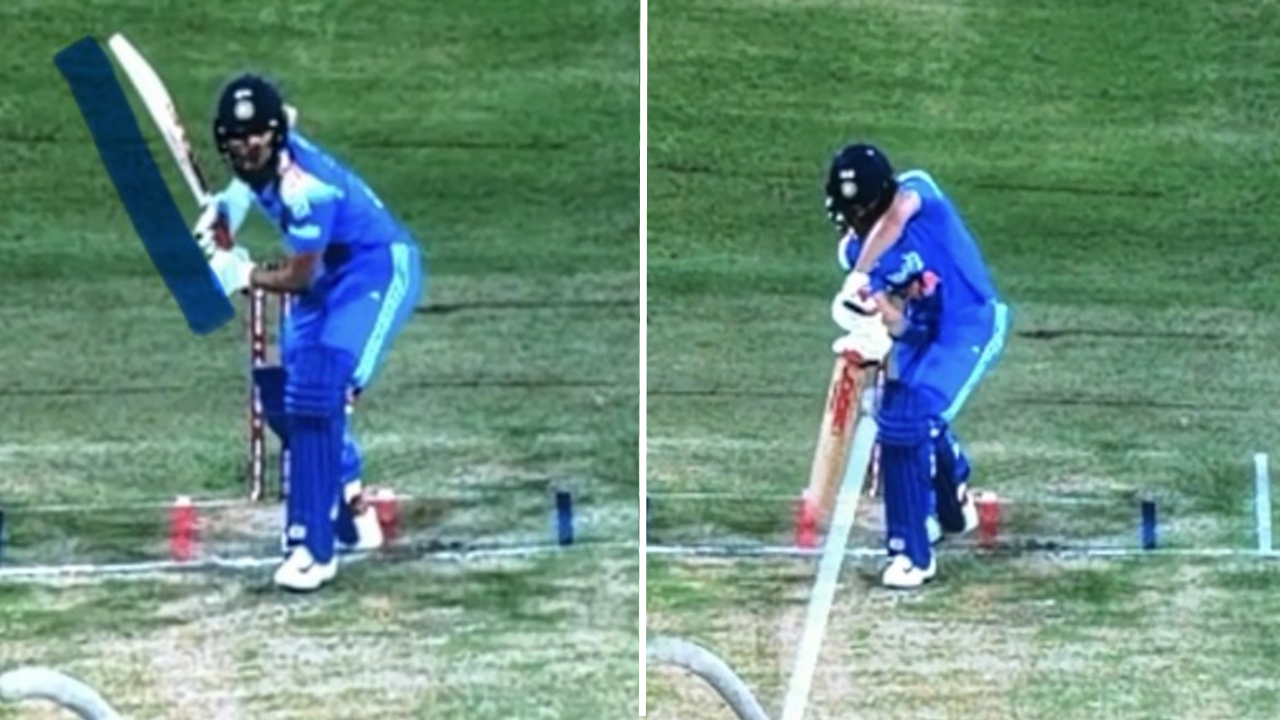
Using a series of frame-by-frame breakdowns, Ashwin highlighted the subtle mechanical flaw that led to Gill's wicket:
The Natural Angle: Gill has a high backlift, with his bat naturally coming down from the direction of "gully" (a fielding position behind the batter). This is his trained, natural position, the foundation of his aggressive stroke play.
Sunny bhai is talking about how Shubman’s bat was really close to the pad in England where he made all his runs.
— Ashwin 🇮🇳 (@ashwinravi99) January 18, 2026
I am going to try and illustrate the challenge for a modern day batter, the changes which happen automatically most of the times when you shift in & out of red ball… pic.twitter.com/2VovLVJimT
The Adjustment: As the ball is delivered, Gill correctly identifies the line and realigns his bat to meet it. At this stage, everything looks perfect.
Pic 2 : He has seen the line of the delivery and Re aligned his bat to meet the ball head on and is in superb position thus far.
— Ashwin 🇮🇳 (@ashwinravi99) January 18, 2026
The bat needs to now start curving in to meet the ball such that he doesn’t leave a gap between bat and ball. pic.twitter.com/v97ZB2XxOt
The Fatal Gap: The problem arises as the ball pitches and "ducks back in" (moves sharply towards the batter). To survive this, the bat must curve inwards to close the space between itself and the pad. Instead, a dangerous gap opens up.
Pic 3 : The gap has started to emerge here and he knows he is in trouble because the ball has pitched and started to duck back in.
— Ashwin 🇮🇳 (@ashwinravi99) January 18, 2026
He should be able to release his bottom hand a touch and manoeuvre his hands closer to the pads and handle this delivery. pic.twitter.com/4Se9BT9H0v
The Culprit: The Dominant Bottom Hand
Pic 4 : if you see closely, the bottom hand, which is supposed to be used for dexterity hasn’t loosened up and allowed the last minute adjustment.
— Ashwin 🇮🇳 (@ashwinravi99) January 18, 2026
Even though, he wants to shut the gap down, his bottom hand which is firm on the handle isn’t allowing him to do it. pic.twitter.com/8WOZCgocBC
Here is where Ashwin’s insight humanises the error. He explains that this isn't a lack of skill, but a battle against habit. In ODIs and T20s, batters rely heavily on a strong, firm bottom hand to generate power and hit the ball in the air.
In this specific dismissal, Gill’s bottom hand remained too rigid. To close that gap and defend successfully, he needed to "release" or loosen his bottom hand, allowing his wrists to manoeuvre the bat closer to his pads. Because his muscle memory was stuck in "power mode," the hand stayed firm, the bat couldn't adjust in that split second, and the ball sneaked through.
A Habit, Not a Blunder
Ravichandran Ashwin concluded his thread with a staunch defence of his teammate. He termed Gill a "fab player," clarifying that this wasn't a glaring mistake but a lapse in awareness. It’s a side effect of being a dominant white-ball player; the "natural habitat" for such batters is a strong bottom hand.
In essence, Ashwin’s thread was more than just a critique; it was an educational piece for fans. It showed us that even the best in the world fight against their own instincts, and sometimes, the ghost of a T20 six can cost you a Test match wicket.
